
Research & Projects
Quantum Technologies at the Sensitivity Frontier
Our research program bridges the gap between building foundational tools and making fundamental discoveries. We design, fabricate, and deploy cutting-edge superconducting technologies to explore the world of neutrinos and other weakly interacting particles. Our work is centered on three key areas, each associated with major international experiments and facility development.
Probing Neutrino Interactions at Low Energies
The key to discovering new physics often lies in our ability to see what was previously invisible. Our group specializes in developing detectors with extremely low energy thresholds, capable of sensing the minuscule nuclear recoil from a neutrino interaction or the decay of a single radioactive atom. We leverage advanced materials and quantum sensors, primarily superconducting crystals coupled with Transition-Edge Sensors (TESs) and Superconducting Tunnel Junctions (STJs). These devices act as ultra-sensitive thermometers, converting a tiny deposit of heat into a measurable electrical current. This work is central to our involvement in two key experiments:


The RICOCHET Experiment: This international effort aims to make the first definitive observation of Coherent Elastic Neutrino-Nucleus Scattering (CEvNS) at a nuclear reactor. Our group develops novel, ultra-sensitive cryogenic detectors designed to sense the tiny energy—on the order of tens of electron-volts—produced by this rare process. Observing CEvNS will test the Standard Model in a new regime and open doors for applications like reactor monitoring.
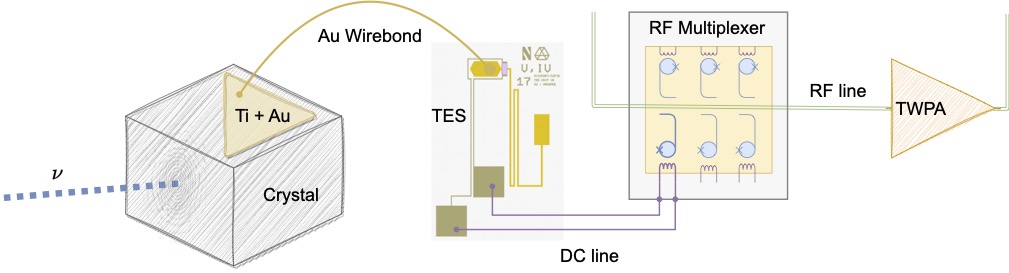


The BeEST Experiment: This experiment searches for evidence of physics beyond the Standard Model by performing a high-precision measurement of the decay of Beryllium-7. By embedding radioactive atoms directly into our superconducting sensors, we can measure the recoil energy of the daughter nucleus with world-leading resolution. Any deviation from the expected spectrum could be a sign of new, sterile neutrinos. Our group contributes to developing the multi-pixel sensor arrays and low-noise readout that make this precision possible.

The Quest for Neutrino Mass: Project 8

Determining the absolute mass of the neutrino is one of the most critical open problems in particle physics. Our group is a key member of the Project 8 collaboration, which is pioneering a revolutionary technique called Cyclotron Radiation Emission Spectroscopy (CRES). Instead of measuring an electron’s energy with a traditional calorimeter, CRES precisely measures the frequency of the faint microwave radiation it emits while spiraling in a magnetic field. Because frequency can be measured with extraordinary precision, CRES has the potential to measure the neutrino mass with unparalleled sensitivity. Our group contributes expertise in developing the quantum-limited microwave amplifiers and readout systems essential for detecting these incredibly faint, single-electron signals.

Building the Ultimate Quiet Environment: CURIE

To push the sensitivity frontier, we must first escape the noise of our own world. Cosmic rays constantly bombard the Earth, creating a background that can overwhelm the subtle signals we hunt for. Our group is leading the effort to establish the Colorado Underground Research Institute (CURIE) at the Edgar Experimental Mine. Located 200 meters underground, this facility provides a 700-fold reduction in the cosmic ray muon flux. CURIE is not just a location, but a research instrument in itself: an ultra-low-background, cryogenically capable environment equipped with state-of-the-art infrastructure. It serves as a unique national resource for developing and benchmarking the next generation of superconducting sensors, quantum devices, and low-threshold detectors that will power future discoveries.

